Senator James Eastland by Maarten Zwiers
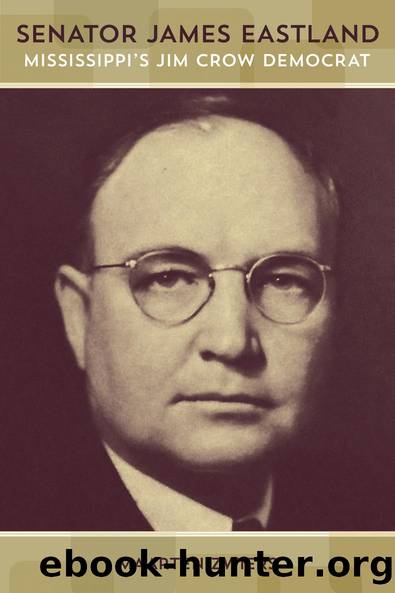
Author:Maarten Zwiers [Zwiers, Maarten]
Language: eng
Format: epub
Tags: Biography & Memoir, Literary, Nonfiction, History, Americas, United States, Social & Cultural Studies, Political Science
ISBN: 9780807160039
Publisher: LSU Press
Published: 2015-06-15T04:00:00+00:00
ââââââ
CHAPTER 6
ââââââ
THE ERA OF POWER POLITICS
Kennedy and Eastland
IN SEPTEMBER 1956, an editorial titled âWhither Goest Thou, Senator?â appeared in the Simpson County News. This newspaper from the Mississippi Hill Country clearly was no ally of Senator Eastland. The editors wrote it as a response to a letter by C. C. Jones, who objected to Eastlandâs endorsement of the national Democratic ticket. âTo deny that the Democratic Party has been drifting toward socialism, which endangers democracy and individual freedom would be stupid, and contrary to all known facts. Such drifting lays the foundation for Communism, or a ruthless dictatorship,â declared Jones, a retired Baptist pastor and president of the Citizensâ Council in Simpson County. He then stated that he could not vote for the Democratic ticket. Eastland expressed his approval of the pastorâs views and congratulated him on the soundness of his position. The editors of the Simpson County News were astonished. They printed both letters in their newspaper and asked whether Eastland was still going to vote for Stevenson and Kefauver, despite the words he wrote to Jones. Was the senator a Democrat, or a Republican in disguise (something he had been accused of before)? âEvidently Senator Eastland has dropped his cigar and is talking out of both sides of his mouth,â the newspaper wryly noted. The editors warned Eastland not to play both sides of the fence but to stick to one statement. They thought the Democratic Party was actually better off without the Delta planter in its ranks. âBro. Jones plans to go fishing on Presidential Election Day, and the Editors of your Simpson County News will vote the Democratic ticket,â the editorial concluded. âWonder what âSquireâ Jim will do? Buy a saddle for fence straddling?â1
As the civil rights struggle intensified during the 1960s, the issue of Democratic âfence straddlingâ moved to the foreground. James Eastland was not the only Democrat who faced such allegations; in a party that housed southern segregationists as well as northern liberals, Democratic politicians often had to find an agreement that was acceptable to both wings of the party. Particularly Democrats with national ambitions could not escape this reality. The politics that surrounded the Civil Rights Act of 1957 demonstrated how difficult it was to formulate meaningful legislation that did not offend any of the major sections in the Democratic Party. The compromise forged by Lyndon Johnson required the support of Democrats from all regions of the nation. The final result boosted LBJâs chances for the presidency, but it also benefitted another Democrat who had his eyes on the White House: John F. Kennedy. During the 1957 debate, Kennedy supported both Section III (which pleased African Americans) and the jury trial amendment (which pleased white southerners). His cautious and moderate approach to the civil rights question âreflected the racial dilemma of a would-be Democratic presidential nominee who needed southern support for that aspiration to be realized and a Massachusetts senator facing reelection who needed support in a liberally inclined home state,â one historian noted.
Download
This site does not store any files on its server. We only index and link to content provided by other sites. Please contact the content providers to delete copyright contents if any and email us, we'll remove relevant links or contents immediately.
| Africa | Americas |
| Arctic & Antarctica | Asia |
| Australia & Oceania | Europe |
| Middle East | Russia |
| United States | World |
| Ancient Civilizations | Military |
| Historical Study & Educational Resources |
Cat's cradle by Kurt Vonnegut(15446)
Pimp by Iceberg Slim(14686)
4 3 2 1: A Novel by Paul Auster(12520)
Underground: A Human History of the Worlds Beneath Our Feet by Will Hunt(12148)
The Radium Girls by Kate Moore(12096)
Wiseguy by Nicholas Pileggi(5843)
The Fire Next Time by James Baldwin(5508)
Perfect Rhythm by Jae(5473)
American History Stories, Volume III (Yesterday's Classics) by Pratt Mara L(5340)
Paper Towns by Green John(5248)
Pale Blue Dot by Carl Sagan(5083)
A Higher Loyalty: Truth, Lies, and Leadership by James Comey(5020)
The Doomsday Machine by Daniel Ellsberg(4557)
The Mayflower and the Pilgrims' New World by Nathaniel Philbrick(4542)
Killers of the Flower Moon: The Osage Murders and the Birth of the FBI by David Grann(4490)
The Sympathizer by Viet Thanh Nguyen(4449)
Too Much and Not the Mood by Durga Chew-Bose(4391)
The Borden Murders by Sarah Miller(4387)
Sticky Fingers by Joe Hagan(4257)
